

Andy Warhol (1928–1987) is known for soup cans and Marilyn Monroe. At almost the same time he printed images of accidents, executions and suicides onto canvas, pictures from the newspaper, repeated many times. One of the earliest hangs at K20 in Düsseldorf: “A Woman’s Suicide” of 1962.
From commercial artist to Pop artist
Andy Warhol was born in Pittsburgh in 1928 and died in New York in 1987.1 In the 1950s he was a sought-after commercial illustrator. In the early 1960s he painted subjects from the world of goods: cans, bottles, banknotes.
In 1962 he adopted a technique from advertising, screenprinting. It allowed him to transfer a photograph from a newspaper or magazine onto canvas as often as he liked.2 He used it as his regular way of working from late summer 1962.3 The artist’s hand recedes. But Warhol let the screen deliver too much or too little ink, so that smudges and gaps disrupt every image.2
Death and disaster
That same year he began the group of works later known as “Death and Disaster”. Warhol himself named a front page as the trigger: “129 DIE”, the headline about a plane crash.4 Car crashes, the electric chair, suicides and images of police violence against the civil rights movement followed.2
All the subjects come from the press. Warhol invents nothing; he selects, enlarges and repeats. In doing so he raises a question that is still open today: what does it do to us when we see the same picture of disaster again and again?
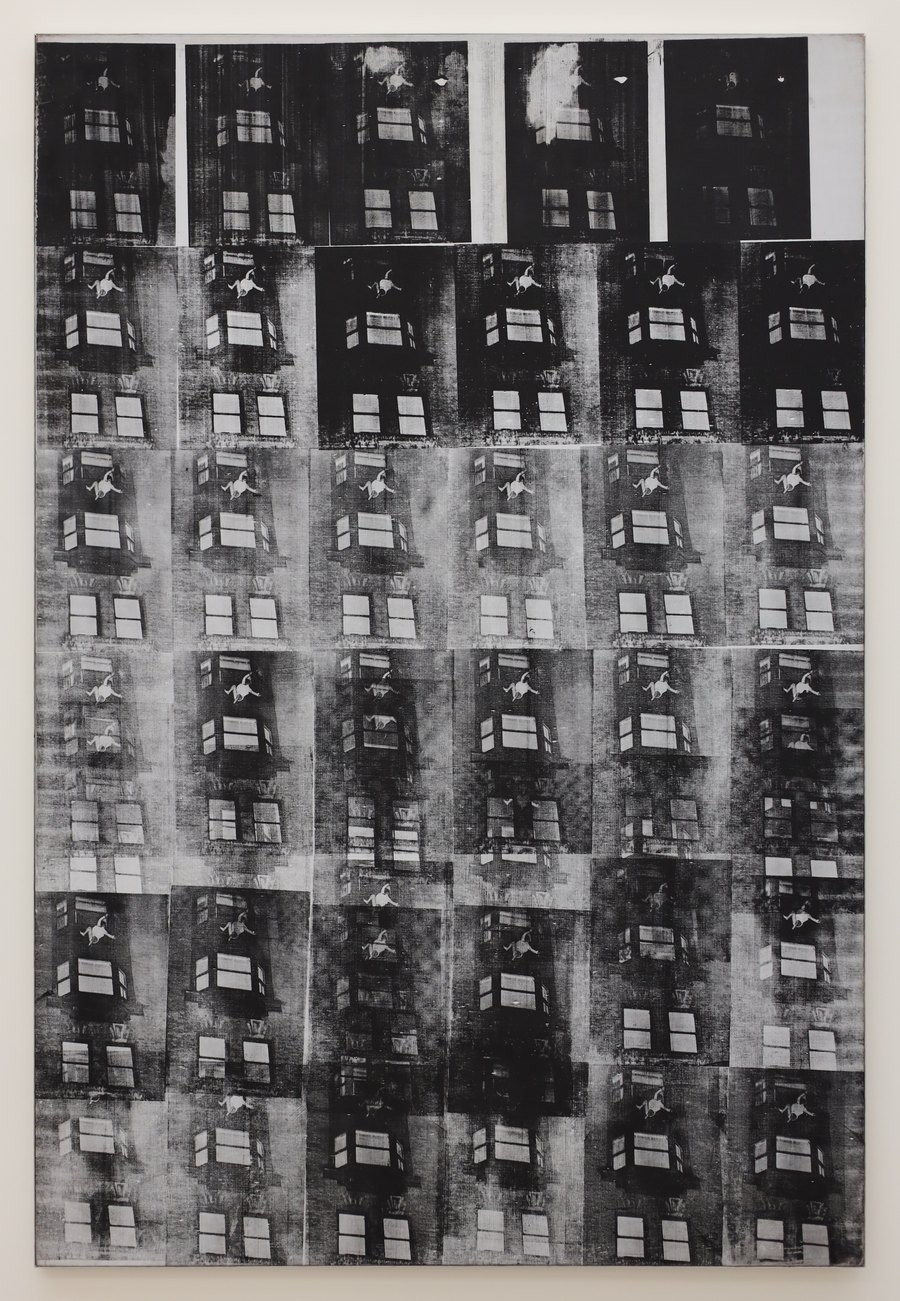
A Woman’s Suicide: one press photo, printed many times
The source is a photograph from the agency International News Photos. It shows a 14-year-old girl moments after she jumped from the 11th-floor ledge of a New York hotel. The caption reports that hundreds of onlookers watched for half an hour as she paced the ledge.2 I deliberately do not name her here.
The illustration above shows what Warhol made of it. The same photograph appears in six rows, more than thirty times. The façade, the windows and the small pale figure in front of them repeat, yet no print is like another. Some rows are almost black, others pale and grey. In the top row there are light strips between the prints; further down, individual prints shift or overlap.
The picture is more than three metres high. Standing in front of it, you first see a grid of windows and only at second glance what is happening in it.
Printed on the floor
Film footage from Warhol’s studio in mid-December 1962 shows him printing exactly this picture on the floor.3 The canvas lies flat and the artist works from above. That recalls Jackson Pollock, who also laid his canvases on the floor. But where every line in Pollock is the trace of a movement, Warhol’s movement remains mechanical: lay down the screen, pull the ink through, move the screen on.
The flaws are different too. In Pollock they arise from the gesture, in Warhol from the process. Too much ink turns an image black; too little makes it fade. It is precisely these accidents that make each image in the grid individual.
Numbed, or looking harder?
Repetition works in two directions. It can wear the horror down, like a news item read for the tenth time. But it can also intensify it, because the image will not let go. Tate describes the effect of the “Death and Disaster” pictures in exactly this way: emphasised and undermined at the same time.2
“A Woman’s Suicide” also exposes how many people were already watching at the time. Hundreds stood in the street below, a photographer captured the moment, the newspaper printed it. Warhol prints it again, dozens of times. Tate speaks of the voyeurism inherent in media coverage of traumatic events.2 Anyone standing in front of the picture is part of it.
The way to Düsseldorf
Warhol kept the picture until 1970. It then went to Galerie Bischofberger in Zurich, and in 1972 the Kunstsammlung Nordrhein-Westfalen acquired it.1 Since then it has been shown in major Warhol exhibitions: in 2001 at the Neue Nationalgalerie in Berlin, in 2014 in the exhibition “Death and Disaster” in Chemnitz, and in 2020/21 in the Tate Modern retrospective, which then travelled to Cologne, Toronto and Aspen.1
Today it is on display at K20.1 There it can be set beside the collection’s other Americans: beside Pollock’s gesture, and beside Roy Lichtenstein, who, like Warhol, took images from the mass media but repainted them by hand with halftone dots.
If you are having thoughts of suicide or are worried about someone, help is available. You can find free, confidential helplines in your country at findahelpline.com.
Sources
- Kunstsammlung Nordrhein-Westfalen, online collection: Andy Warhol, A Woman’s Suicide, 1962, inv. no. 0187, with provenance and exhibition history. sammlung.kunstsammlung.de
- Tate Modern: Andy Warhol, Large Print Guide to the exhibition, 2020, room texts on the introduction of screenprinting and on “A Woman’s Suicide”. tate.org.uk
- Gary Comenas: The Warholstars Timeline 1960–1962, with references to the catalogue raisonné. warholstars.org
- Gene Swenson: What is Pop Art? Interview with Andy Warhol. In: Art News, vol. 62, November 1963. Quoted from source 3. The authenticity of some answers in this interview is disputed.